A straight-talking cost breakdown for CTOs who are tired of squinting at cloud invoices that somehow keep growing.
Let me paint you a familiar picture.
It's the end of the quarter. Your CFO slides a spreadsheet across the table - metaphorically, of course, because you're on Zoom - and points at a line item that reads "Cloud Infrastructure: $1.2M." You nod confidently. Then you go back to your desk and quietly Google: "why is our AWS bill so high?"
You're not alone. In 2026, global cloud spend is on track to blow past $700 billion, and research suggests that 20–35% of it is pure waste. That's money sitting in idle instances, bloated storage tiers, and the sneakiest villain of all: data transfer fees that nobody budgeted for.
Here's the real question: across AWS, Azure, and GCP, where exactly are you getting overcharged - and what can you actually do about it?
Let's get into it.
The Big Three in 2026: A Quick Snapshot
Before we go line-by-line on the bills, let's be clear about what we're comparing. AWS, Azure, and GCP each dominate different slices of the enterprise market:
- AWS - the incumbent. Most mature ecosystem, widest service catalog, most complex billing. Still the default choice for most startups and independent SaaS companies.
- Azure - the Microsoft orbit. If your org runs on Microsoft 365, Active Directory, or Windows Server, Azure is almost certainly already in your stack. Enterprise licensing discounts are real and significant.
- GCP - the data and AI play. Google's custom silicon (TPUs, Axion processors) and flexible committed use discounts make it genuinely compelling for AI/ML workloads and data-heavy architectures.
Each has distinct strengths. Each also has distinct ways of quietly inflating your bill if you're not paying attention.
Round 1 - Compute Costs: Who's Actually Cheaper?
Let's start with the most obvious cost: virtual machines. Here's a real-world apples-to-apples comparison for a mid-range instance (roughly 5 vCPU, 10 GB memory):
| Pricing Model | AWS (t3.xlarge) | Azure (D4s v3) | GCP (N2-standard-4) |
|---|
| On-Demand | $0.1664/hr (~$121/mo) | $0.192/hr (~$140/mo) | $0.1292/hr (~$94/mo) |
| Reserved / CUD (1yr) | $0.099/hr (~$72/mo) | $0.095/hr (~$69/mo) | $0.078/hr (~$57/mo) |
| Spot / Preemptible | $0.0499/hr (~$36/mo) | $0.053/hr (~$39/mo) | $0.0387/hr (~$28/mo) |
GCP wins on raw compute price, especially at on-demand and spot tiers. But here's the thing - raw compute is rarely where organizations lose the most money. The real overspending happens in the hidden layers.
One subtle advantage GCP has over AWS and Azure: Committed Use Discounts (CUDs) are flexible across machine families, whereas AWS Reserved Instances lock you into specific instance types. If your workload shifts - and it will - AWS's rigidity can leave you holding reservations you can't fully use.
Round 2 - The Egress Tax: The Bill Nobody Talks About Enough
This is the one that genuinely makes me grind my teeth every time I audit a cloud bill. Egress fees - charges for moving data out of a cloud provider - are among the fastest-growing and least-audited line items in enterprise cloud bills in 2026. Here's what each provider charges per GB for internet-bound traffic:
| Provider | First 100 GB/mo | Next tier | At scale (1–10 TB) |
|---|
| AWS | Free | $0.09/GB | $0.09/GB |
| Azure | Free | $0.087/GB | $0.083/GB |
| GCP | Free | $0.12/GB (first TB) | $0.08/GB (1–10 TB) |
GCP looks expensive at first glance, but drops to $0.08/GB at scale - competitive with Azure. AWS holds flat at $0.09/GB.
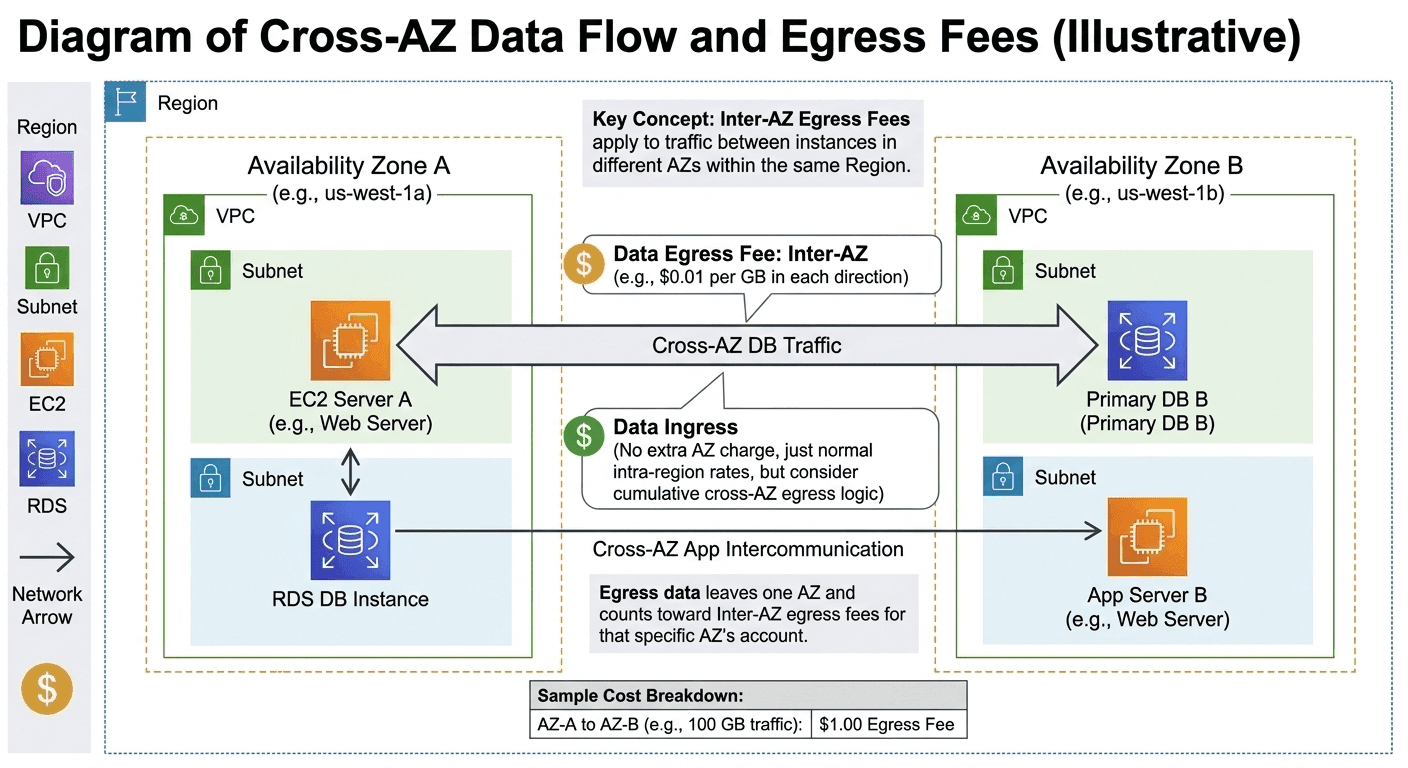
What makes egress truly dangerous isn't the per-GB rate - it's the volume you accumulate without realizing it. Consider this: transferring 10 TB out of AWS per month costs roughly $900 in egress alone. And if you're running a three-AZ architecture with 500 GB/day of inter-zone traffic? Add another $300/month in cross-AZ transfer fees - that's $3,600/year for traffic that never even leaves AWS's own network.
There's a dark poetry to it: ingress is free, egress is taxed. The cloud providers want your data in. Getting it back out is expensive by design.
Quick fix for egress: Use VPC Endpoints on AWS, Private Link on Azure, and Private Service Connect on GCP to route internal traffic off the public internet and eliminate inter-service egress charges entirely.
Round 3 - Storage: Where Tier Selection Makes or Breaks Your Bill
Storage billing looks simple until it doesn't. Here's where each provider creates traps for the unwary:
| Storage Tier | AWS S3 | Azure Blob | GCP Cloud Storage |
|---|
| Standard | $0.023/GB | $0.018/GB | $0.020/GB |
| Infrequent Access | $0.0125/GB | $0.01/GB | $0.01/GB |
| Archive/Cold | $0.004/GB (Glacier IR) | $0.001/GB | $0.0012/GB |
| API Reads (per 1k) | $0.0004 | $0.004 | $0.0004 |
Azure has the lowest archive storage cost - but its API read fees are 10x higher than AWS and GCP. If you're doing API-heavy workloads with high-frequency object reads, Azure Blob can actually end up more expensive than AWS S3 despite having a lower per-GB price. That is a trap I've seen bite teams repeatedly.
Meanwhile, GCP recently raised multi-region storage costs by up to 25% - so if you haven't reviewed your GCP bucket placement and storage class recently, now is the time.
Smart storage hygiene:
- Set lifecycle policies to automatically transition objects to cheaper tiers after 30 days
- Audit S3/Blob/GCS buckets for objects that haven't been accessed in 90+ days
- Consider S3 Intelligent-Tiering if your access patterns are unpredictable - it automates tier selection
Round 4 - Reserved Instances vs. Savings Plans: The Commitment Trap
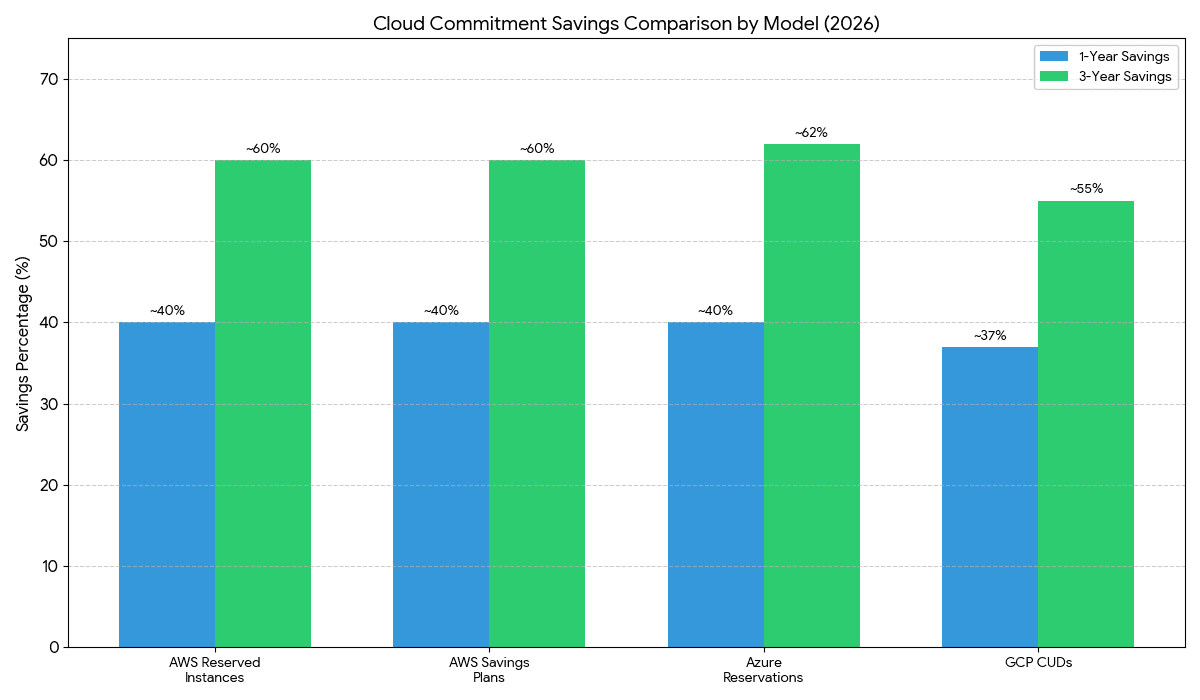
Let's talk about the discount models, because this is where multi-year commitments can either save you 40–72% or handcuff you to infrastructure you no longer need.
| Commitment Model | Provider | Savings (1yr) | Savings (3yr) | Flexibility |
|---|
| Reserved Instances | AWS | ~40% | ~60% | Low - instance-type specific |
| Savings Plans | AWS | ~40% | ~60% | Medium - flexible across EC2, Lambda, Fargate |
| Azure Reservations | Azure | ~40% | ~62% | Low - VM-series specific |
| Committed Use Discounts (CUDs) | GCP | ~37% | ~55% | High - flexible across machine families |
| Sustained Use Discounts | GCP | Up to 30% | N/A | Automatic - no commitment required |
GCP's Sustained Use Discounts deserve special attention. They kick in automatically when you run a resource for more than 25% of the month - no purchase, no commitment, no paperwork. For teams that don't have a dedicated FinOps function yet, this is genuinely valuable.
AWS's rigidity around Reserved Instances is a well-documented source of waste. Teams buy 3-year RIs for workloads they're confident will be stable - then a product pivot happens, and they're holding reservations for instances they've downsized. ProsperOps and Vantage's Autopilot exist largely to solve this exact problem.
The Hidden Costs Nobody Puts in the Budget
Beyond compute, storage, and egress, here are the line items that surprise teams most often in 2026:
- NAT Gateways: $32–45/month each, plus data processing fees - and most architectures have several
- Public IPv4 Addresses: All three providers now charge ~$3.60–4/month per IP for addresses not attached to running instances. AWS started charging in 2024; Azure and GCP followed
- Load Balancers: $18–25/month each before traffic charges
- CloudWatch / Azure Monitor / Cloud Logging: Excessive logging at DEBUG level in production is one of the most common sources of surprise observability bills
- Data Transfer between regions: AWS charges $0.02/GB for inter-region traffic - a microservices architecture spread across us-east-1 and eu-west-1 can accumulate thousands per month without anyone noticing
How to Actually Fix This: A Practical Playbook
Enough diagnosis. Here's the prescription.
Step 1 - Get Multi-Cloud Visibility in One Place
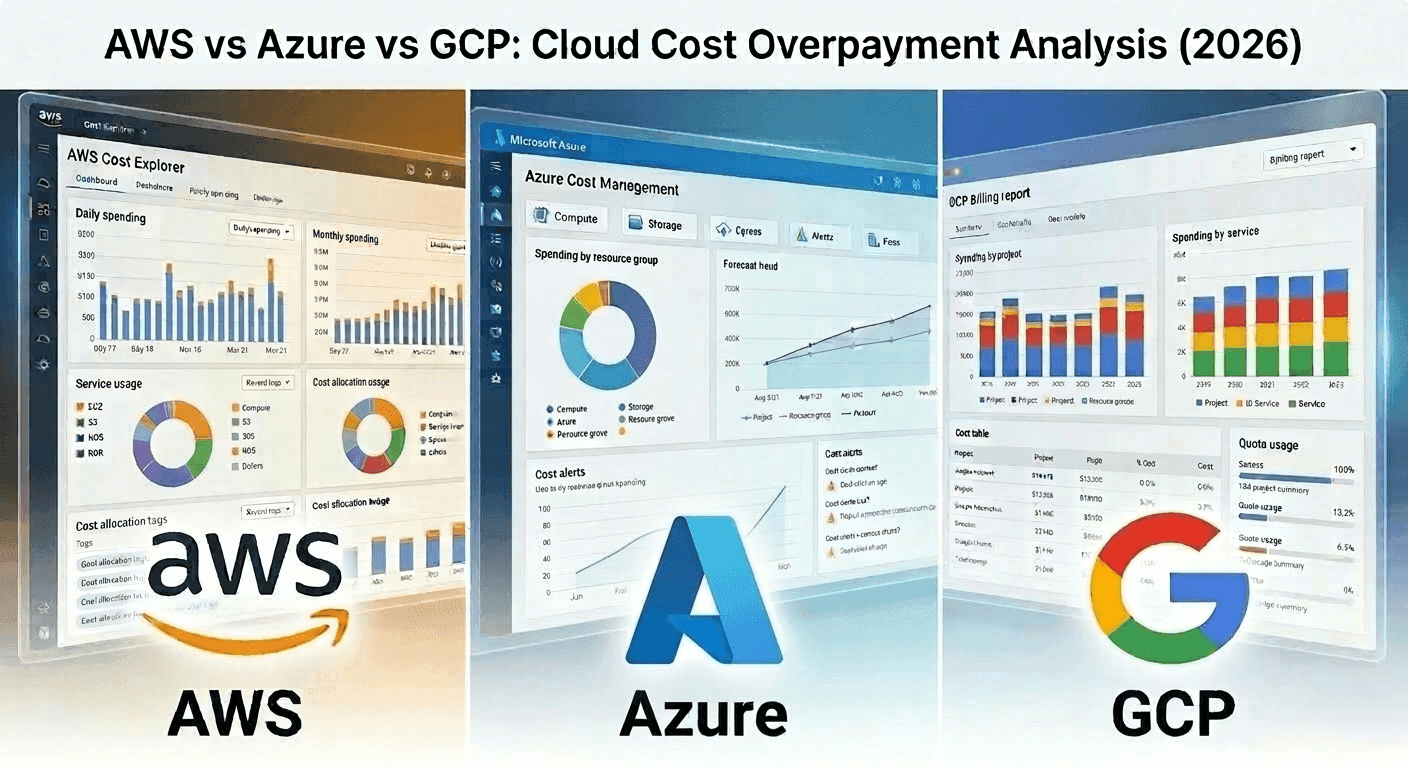
If you're on multiple clouds, you need a unified cost view. Native tools (AWS Cost Explorer, Azure Cost Management, GCP Billing) work within their own silo - they'll never show you the full picture. Tools like Finout, Cloudchipr, and Holori aggregate all three clouds plus Kubernetes into one dashboard.
# Using Infracost to estimate cost impact before deploying infra changes
# Works with AWS, Azure, GCP - integrated into your CI/CD pipeline
infracost diff   --path ./terraform/environments/prod   --format json   --out-file /tmp/infracost-prod.json
infracost comment github   --path /tmp/infracost-prod.json   --repo $GITHUB_REPOSITORY   --github-token $GITHUB_TOKEN   --pull-request $PR_NUMBER   --behavior update
This puts a cost estimate on every infrastructure pull request - before anything is deployed. Shift-left cost management: brilliant in concept, trivially easy to implement.
Step 2 - Right-Size Aggressively (Especially on Azure)
Azure VMs are consistently priced 10–15% higher than AWS equivalents at on-demand rates. If your Azure workloads are running at under 30% CPU utilization - which the industry average suggests most are - right-sizing to one tier smaller immediately recaptures that premium.
# Python script to identify oversized EC2 instances using boto3
import boto3
from datetime import datetime, timedelta
cloudwatch = boto3.client('cloudwatch')
ec2 = boto3.client('ec2')
def get_avg_cpu(instance_id, days=14):
    response = cloudwatch.get_metric_statistics(
        Namespace='AWS/EC2',
        MetricName='CPUUtilization',
        Dimensions=[{'Name': 'InstanceId', 'Value': instance_id}],
        StartTime=datetime.utcnow() - timedelta(days=days),
        EndTime=datetime.utcnow(),
        Period=86400,
        Statistics=['Average']
    )
    datapoints = response['Datapoints']
    if not datapoints:
        return 0
    return sum(d['Average'] for d in datapoints) / len(datapoints)
instances = ec2.describe_instances(Filters=[{'Name': 'instance-state-name', 'Values': ['running']}])
for reservation in instances['Reservations']:
    for instance in reservation['Instances']:
        iid = instance['InstanceId']
        itype = instance['InstanceType']
        avg_cpu = get_avg_cpu(iid)
        if avg_cpu < 10:
            print(f"  {iid} ({itype}) - avg CPU: {avg_cpu:.1f}% - RIGHT-SIZING CANDIDATE")
Step 3 - Enforce a Cloud Cost Tagging Strategy
Without tags, cost allocation is guesswork. Every resource needs at minimum:
- Owner / Team
- Environment (prod / staging / dev)
- Project or Product
- Cost Center
Enforce tagging at provisioning time via Terraform or AWS Service Control Policies (SCPs). Any untagged resource should trigger an alert or auto-tag exception workflow.
Step 4 - Build a FinOps Culture, Not Just a FinOps Tool
Tools don't save money. People using tools save money. The FinOps maturity model - Crawl → Walk → Run - is a useful framework for where to start:
- Crawl: Get visibility. Tag everything. Set budget alerts. Know who owns what.
- Walk: Build team-level cost dashboards. Start reserved instance coverage. Detect anomalies.
- Run: Automate everything. Autonomous RI management. AI anomaly detection. Cost checks in CI/CD.
Most organizations underestimate how long the Crawl phase takes. Don't skip it.
The Verdict: AWS vs Azure vs GCP - Where Are You Overpaying Most?
| Cost Category | Most Expensive | Cheapest | Watch Out For |
|---|
| On-demand compute | Azure | GCP | AWS charges 28% more than GCP on comparable instances |
| Reserved/committed | Azure (1yr) | GCP (CUDs) | AWS RI inflexibility leads to wasted commitments |
| Egress (first TB) | GCP ($0.12/GB) | Azure ($0.087/GB) | GCP drops to $0.08/GB at scale |
| Storage (standard) | AWS ($0.023/GB) | Azure ($0.018/GB) | Azure API read fees are 10x higher |
| Spot / preemptible | Azure | GCP | All three are great; GCP is cheapest |
| Automatic discounts | AWS / Azure (none) | GCP | GCP's Sustained Use Discounts require zero effort |
The honest answer? No single provider is cheapest for everything. AWS's ecosystem depth and global reach command a premium. Azure's real value is the Microsoft licensing bundle - if you're not leveraging Azure Hybrid Benefit and EA discounts, you're paying retail for enterprise software. GCP offers the best raw compute economics and the most flexibility on commitments, but its egress and storage pricing can surprise you.
The most expensive cloud isn't the one with the highest list prices. It's the one you don't have visibility into.
Frequently Asked Questions
Which cloud provider is cheapest overall in 2026?
GCP typically wins on raw compute, especially with Sustained Use Discounts applied automatically. But total cost depends heavily on your workload mix, data transfer patterns, and existing vendor relationships.
Do I need a third-party tool if I use AWS Cost Explorer?
Yes, if you're on multiple clouds. AWS Cost Explorer only shows AWS spend. Third-party tools like Finout, Vantage, or CloudZero provide unified multi-cloud visibility, anomaly detection, and automation that native tools can't match.
What's the single fastest way to reduce my cloud bill right now?
Shut down non-production environments outside business hours. It takes an afternoon to set up and typically saves 20–30% of dev/staging compute costs overnight.
Are cloud prices going up in 2026?
Yes. Cloud prices are expected to rise 5–10% in 2026 as providers pass through increased server hardware costs. This makes proactive cost optimization more important than ever.

The cloud bill isn't going to optimize itself. But with the right visibility, the right commitment strategy, and a team that's bought into cost ownership, you can absolutely cut 20–40% of what you're currently spending - without touching a single line of application code.
Start with one question this week: "What are our top 10 cost drivers - and does each one have a named owner?"
If you can't answer that, you've found your first project.